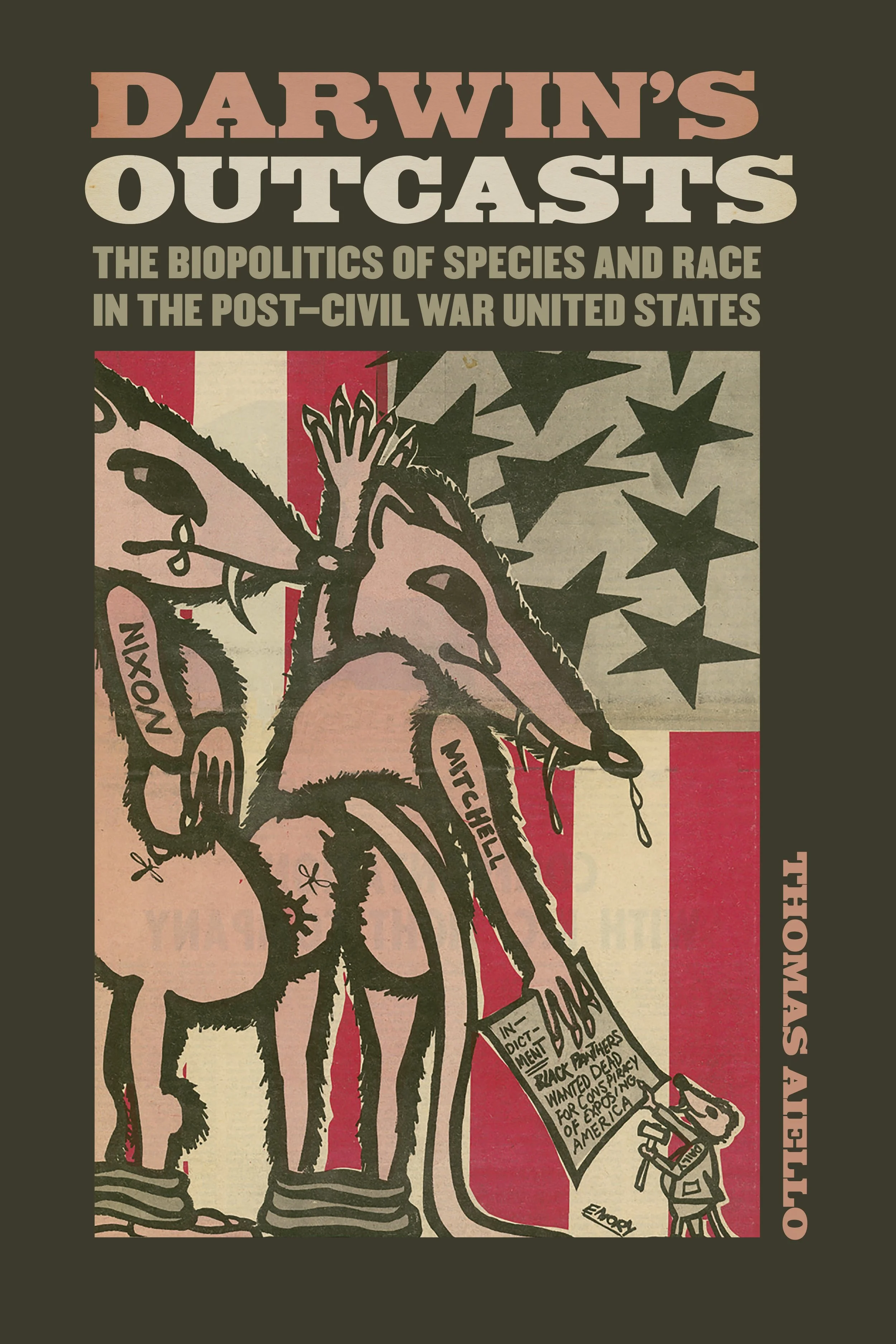
DARWIN’S OUTCASTS:
The Biopolitics of Species and Race in the Post-Civil War United States
Speciesism and racism were present from the beginning of the nation, but the rupture in white racism at having a population it had intentionally animalized take on the mantle of citizenship forced a change in racist tactics and a change in how the formerly enslaved resisted white supremacy. The human consequences of evolving racist expedients at the individual and system levels and the concomitant Black resistance they generated drove—and still drive—much of American policy. One constant in the evolutionary process has featured white reifications of the trope of animalization and Black strategies of opposition to those tropes. That fight along hierarchical lines, then, has also maintained significant consequences for animals themselves, who were always at the bottom of those hierarchies. Or, put more simply, American racism targets human groups who are its most immediate victims; but American racism also hurts animals. In a nation whose development has been largely defined by its racial thinking and dispossessions, the consequences for nonhuman animals as collateral damage of those human bigotries is significant. And like racism itself, that damage to animals still remains.
Human relationships with animals typically fall under the purview of scientists, ethicists, lawyers, and philosophers. The narrative has a relatively consistent historiography that involves tracking direct human contact with or advocacy for animals in various ways. What that narrative often ignores is the American historical and cultural context that emphasizes less idealistic questions and more pragmatic incidents of how humans in the United States have the notion of human superiority and speciesism reinforced for them, reinforcements that appear in economics, semiotics, literature, language, and news. Those incidents often interact with the other dominant form of American dispossession, that of racial bigotry, in surprising ways. Darwin’s Outcasts tracks the assumption of human supremacy in the development of United States culture from the post-Reconstruction period to the present, emphasizing in particular its intersection with and reinforcement by white supremacy. As Cary Wolfe has explained, “you can’t talk about biopolitics without talking about race, and you can’t talk about race without talking about species, simply because both categories—as history well shows—are so notoriously pliable and unstable, constantly bleeding into and out of each other.” This book is an analysis of that bleeding.